What BBN said on air. The facts are in the original report: ScienceDaily.
Hank LedgerAstronomers may have found the first moon ever detected beyond our Solar System, and it orbits a brown dwarf that itself circles a star, ScienceDaily reports.
Vera BullockA moon, orbiting a brown dwarf, orbiting a star. Somewhere a genealogist is weeping with joy.
Hank LedgerIt's at least as massive as Jupiter. The brown dwarf it orbits is about thirty-seven times Jupiter's mass.
Vera BullockBiggest moon in history, and it still hasn't been allowed to be a moon. That's what I call a pipeline.
Hank LedgerThe researchers won't call it a moon yet. For now they say exosatellite, because it is decidedly unmoon-like.
Vera BullockUnmoon-like.
Hank LedgerThe lead author, Kevin Hoy, says the system is "super weird." And that it's hard to define using words like planet and moon.
Hank LedgerThey found it, and they're being so careful with it.
Vera BullockSix thousand planets found outside our system and never one confident moon, and now one shows up and they're gentle about the label.
Vera BullockThe study in Nature calls it a promising detection, not a confirmed one, and I think that's a very healthy way to introduce yourself.
Hank LedgerA promising detection. Seventy-three light-years away and nobody wants to hurt its feelings.
Vera BullockExosatellite. Unmoon-like, promising, not confirmed. Hank, that's my whole performance review.

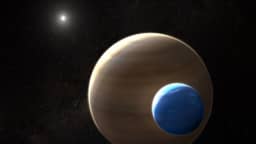
 Photo: NASA · CC BY 4.0 · Wikimedia Commons
 @watchBBN

 Photo: Mr.choppers · CC BY-SA 3.0 · Wikimedia Commons
 Photo: Franz Eugen Köhler · Public domain · Wikimedia Commons

 Photo: Markus Koljonen ( Dilaudid ) · CC BY-SA 3.0 · Wikimedia Commons
 Photo: Tormod Sandtorv · CC BY-SA 2.0 · Wikimedia Commons
 Photo: Lea Maimone · CC BY-SA 2.0 · Wikimedia Commons

 Photo: Tokumeigakarinoaoshima · CC0 · Wikimedia Commons
 Photo: Raysonho @ Open Grid Scheduler / Grid Engine · CC0 · Wikimedia Commons

 Photo: Antiquary · CC BY 4.0 · Wikimedia Commons

 Photo: Wikimedia Commons · CC BY-SA 3.0 · Wikimedia Commons

 Photo: Paul Wiegmans · Public domain · Wikimedia Commons
 Photo: Johannes Eva (for · CC BY-SA 4.0 · Wikimedia Commons

 Photo: Dissident93 · CC0 · Wikimedia Commons
 Photo: Rushen · CC BY-SA 2.0 · Wikimedia Commons

 Photo: Benh LIEU SONG ( Flickr ) · CC BY-SA 4.0 · Wikimedia Commons
 Photo: Quintin Soloviev · CC BY 4.0 · Wikimedia Commons

 Photo: Wilfredor · CC0 · Wikimedia Commons
 Photo: Gee Jay · CC BY 2.0 · Wikimedia Commons

 Photo: David Gahr · Public domain · Wikimedia Commons
 Photo: Robert.Harker · CC BY-SA 3.0 · Wikimedia Commons
 Photo: Ruanxian Dai · CC BY 4.0 · Wikimedia Commons