
Weird NewsGOOD NEWS
Astronomers may have found the first moon beyond our Solar System
The object is at least as massive as Jupiter and orbits a brown dwarf about thirty-seven times Jupiter's mass; researchers call it a promising detection, not a confirmed one.

 On air: Hank Ledger and Vera Bullock on Finally, Some Good News
Published
Watch it as it aired: Hank Ledger and Vera Bullock on this story, from Finally, Some Good News at 1:45 PM ET. Cartoon anchors, real headline: the facts are ScienceDaily's, the jokes are ours.
At a glance
- First reported by ScienceDaily: “Astronomers may have discovered the first moon beyond our Solar System”, with reporting from Phys.org, The Register and Nature.
- Covered on BBN on Sunday, October 25, 2026, at 1:45 PM ET on Finally, Some Good News, by Hank Ledger and Vera Bullock.
The real story
The reporting behind this segment. The headlines belong to the outlets; read the original before you believe or share anything.
- ScienceDailyAstronomers may have discovered the first moon beyond our Solar System
- Phys.orgJupiter-mass 'exomoon' orbiting brown dwarf challenges cosmic labels July 23, 2026 · facts used on air
- The RegisterAstronomers spot exomoon candidate that's almost as massive as Jupiter July 22, 2026 · facts used on air
- NaturePlanetary-mass exosatellite detected around the substellar companion of a star facts used on air
What BBN said about it
Hank Ledger · Lead AnchorAstronomers may have found the first moon ever detected beyond our Solar System, and it orbits a brown dwarf that itself circles a star, ScienceDaily reports.
Vera Bullock · Co-AnchorA moon, orbiting a brown dwarf, orbiting a star. Somewhere a genealogist is weeping with joy.
Hank Ledger · Lead AnchorIt's at least as massive as Jupiter. The brown dwarf it orbits is about thirty-seven times Jupiter's mass.
Vera Bullock · Co-AnchorBiggest moon in history, and it still hasn't been allowed to be a moon. That's what I call a pipeline.
Hank Ledger · Lead AnchorThe researchers won't call it a moon yet. For now they say exosatellite, because it is decidedly unmoon-like.
Vera Bullock · Co-AnchorUnmoon-like.
Hank Ledger · Lead AnchorThe lead author, Kevin Hoy, says the system is "super weird." And that it's hard to define using words like planet and moon.
Hank Ledger · Lead AnchorThey found it, and they're being so careful with it.
Vera Bullock · Co-AnchorSix thousand planets found outside our system and never one confident moon, and now one shows up and they're gentle about the label.
Vera Bullock · Co-AnchorThe study in Nature calls it a promising detection, not a confirmed one, and I think that's a very healthy way to introduce yourself.
Hank Ledger · Lead AnchorA promising detection. Seventy-three light-years away and nobody wants to hurt its feelings.
Vera Bullock · Co-AnchorExosatellite. Unmoon-like, promising, not confirmed. Hank, that's my whole performance review.
More Shorts
All videos → Photo: AndrewEnns · CC BY-SA 3.0 · Wikimedia Commons · altered by BBN, shared under CC BY-SA 3.0
 Photo: Mr.choppers · CC BY-SA 3.0 · Wikimedia Commons
 Photo: Franz Eugen Köhler · Public domain · Wikimedia Commons
 Photo: Oleg Yunakov · CC BY-SA 4.0 · Wikimedia Commons · altered by BBN, shared under CC BY-SA 4.0
 Photo: Harald Krichel · CC BY-SA 4.0 · Wikimedia Commons · altered by BBN, shared under CC BY-SA 4.0
 Photo: Bgabel · CC BY-SA 3.0 · Wikimedia Commons · altered by BBN, shared under CC BY-SA 3.0
 Photo: Yathin S Krishnappa · CC BY-SA 3.0 · Wikimedia Commons · altered by BBN, shared under CC BY-SA 3.0




From the archive: everything BBN aired on Sunday, October 25, 2026 · the Weird News archive · all months
More in Weird News
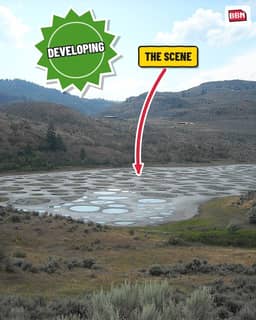
All Weird News →Skip Gets Polka-Dotted at Spotted Lake
The saline alkali lake sits northwest of Osoyoos and is revered by the Syilx Okanagan Nation; its summer pools are strictly look-only.
Knox News launches Shelter Pet of the Week reader vote
Knox News readers vote each week among adoptable dogs and cats, including Roxy, Billabong, Dorianna and Dr Pepper from Young-Williams Animal Center…
What everyone looked up: Saturday, October 24
Wikipedia's English edition logged 53,715 views for a Kentucky crossroads community on October 24; its two bigger rivals that day were a fight card…
Sebastian Stan on why playing Bucky Barnes feels bizarre
Stan has played Bucky since Captain America: The First Avenger in twenty eleven, and says he isn't ready for the story to end; the neighbor stays.