
U.S.WHAT JUST HAPPENED
New comet accidentally discovered by space telescope
The comet, confirmed October eighth, sits over 807 million miles away on an orbit lasting thousands of years; Euclid's own mission plan avoids comet-crowded sky.

 On air: Dr. Nina Byte and Hank Ledger on BBN Newsroom
Published
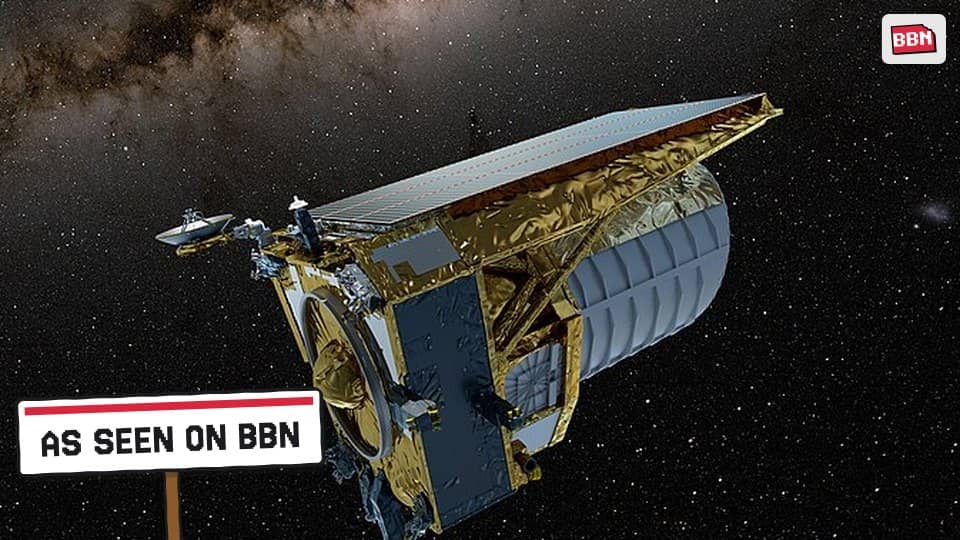 Photo: European Space Agency · CC BY-SA 3.0 igo · Wikimedia Commons · altered by BBN, shared under CC BY-SA 3.0 igo
Watch it as it aired: Dr. Nina Byte and Hank Ledger on this story, from BBN Newsroom at 11:39 AM ET. Cartoon anchors, real headline: the facts are Popular Science's, the jokes are ours.
At a glance
- First reported by Popular Science: “New comet accidentally discovered by space telescope”, with reporting from Euclid Discovers New Comet, Yuba News and ColombiaOne.
- Covered on BBN on Tuesday, October 20, 2026, at 11:39 AM ET on BBN Newsroom, by Dr. Nina Byte and Hank Ledger.
The real story
The reporting behind this segment. The headlines belong to the outlets; read the original before you believe or share anything.
- Popular ScienceNew comet accidentally discovered by space telescope
- Euclid Discovers New Comet, Yuba NewsEuclid discovers new comet facts used on air
- ColombiaOneDark Universe Detective Discovers a Comet in a Little-Observed Region of the Solar System October 19, 2026 · facts used on air
What BBN said about it
Dr. Nina Byte · Tech & Science CorrespondentFour stars again, if anyone's counting. Anyway, a space telescope that wasn't looking for comets just found a comet.
Hank Ledger · Lead AnchorThat's the one-sentence version, and it's accurate. A telescope found something it wasn't looking for.
Dr. Nina Byte · Tech & Science CorrespondentThe European Space Agency reported it Monday.
Dr. Nina Byte · Tech & Science CorrespondentIt's designated C slash twenty twenty-six S one, Euclid, and the Minor Planet Center confirmed it on October eighth.
Hank Ledger · Lead AnchorWhere is it right now?
Dr. Nina Byte · Tech & Science CorrespondentMore than eight hundred seven million miles from Earth. Popular Science says its orbit takes thousands of years to complete.
Hank Ledger · Lead AnchorThousands of years. So it's not a regular visitor.
Dr. Nina Byte · Tech & Science CorrespondentNo. Euclid launched in twenty twenty-three to study dark matter and dark energy by watching distant galaxies.
Hank Ledger · Lead AnchorSo comets aren't its job.
Dr. Nina Byte · Tech & Science CorrespondentWorse. Its six-year mission is mapped to avoid sky crowded with comets and asteroids. That's why this is a surprise.
Hank Ledger · Lead AnchorIt avoided comets and found one anyway.
Dr. Nina Byte · Tech & Science CorrespondentThe comet showed up in images from September sixteenth to twenty-fourth, in the Euclid Deep Field North region.
Hank Ledger · Lead AnchorWho spotted it, if the telescope didn't?
Dr. Nina Byte · Tech & Science CorrespondentA moving object detection program written by an astronomer at the University of Helsinki, because Euclid can't automatically flag such objects.
Hank Ledger · Lead AnchorSo the computer found it.
Dr. Nina Byte · Tech & Science CorrespondentIt's a program, Hank. Fine. The computer.
Dr. Nina Byte · Tech & Science CorrespondentIts author, Mikko Pöntinen, said he was excited to see his software flag a streak across several images.
Hank Ledger · Lead AnchorWho does this affect?
Dr. Nina Byte · Tech & Science CorrespondentMostly astronomers. Nothing suggests any risk to Earth at that distance. It adds a data point on the outer solar system.
Hank Ledger · Lead AnchorIs anyone arguing about it?
Dr. Nina Byte · Tech & Science CorrespondentNot really. Euclid archive scientist Bruno Altieri said very few comets are expected from Euclid, so it was a happy coincidence.
Hank Ledger · Lead AnchorHappy coincidence. I'll take that over most explanations I get.
Dr. Nina Byte · Tech & Science CorrespondentSo, a telescope told to avoid comets, with no way to flag them, found one thanks to Helsinki software.
Hank Ledger · Lead AnchorAnd it won't be back for thousands of years, so nobody can check our work.
More Shorts
All videos → Photo: LasVegasGuy · CC BY-SA 4.0 · Wikimedia Commons · altered by BBN, shared under CC BY-SA 4.0
 Photo: The original uploader was QuicksilverFX0 at English… · CC BY-SA 3.0 · Wikimedia Commons · altered by BBN, shared under CC BY-SA 3.0
 Photo: Frenchieinportland · CC BY 4.0 · Wikimedia Commons · altered by BBN
 Photo: U.S. Department of Defense · Public domain · Wikimedia Commons · altered by BBN
 Photo: Coolsheep2 · CC BY-SA 4.0 · Wikimedia Commons · altered by BBN, shared under CC BY-SA 4.0





From the archive: everything BBN aired on Tuesday, October 20, 2026 · the U.S. archive · all months
More in U.S.
All U.S. →Man convicted of animal cruelty for stealing flamingo from Las Vegas…
Ontario man Mitchell Fairbarn faces up to four years in prison on the felony count, with sentencing set for December first; Peachy the flamingo is…
Powerball Jackpot Rises To $635 Million Ahead Of Wednesday Drawing
The cash option on the jackpot is two hundred sixty-seven point five million dollars before taxes, and the next drawing is Wednesday night; the rest…
Val Chmerkovskiy suspended from 'DWTS' over post after Carrie Ann…
Chmerkovskiy's one-week suspension means he misses Dedication Night; BBC Studios investigated his post under its own protocols, E! News reports, not…

Trump Calls D.C. Golf Course 'Trash Island' After Court Hearing
Judge Ana Reyes rejected a government request to recuse herself in the D.C. Preservation League's challenge; the course is on federal land run by…