
U.S.ASK BBN
Scientists rediscover how Romans made colour-changing glass
Researchers at the University of Sheffield are reported to have replicated the Lycurgus Cup using gold and silver nanoparticles; the Romans managed it without a lab.

 On air: Dr. Nina Byte and Kenji Moonfield on Best of BBN
Published
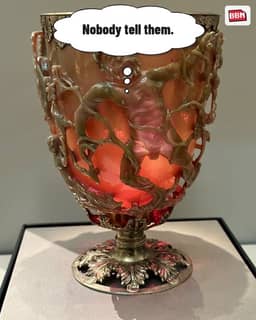
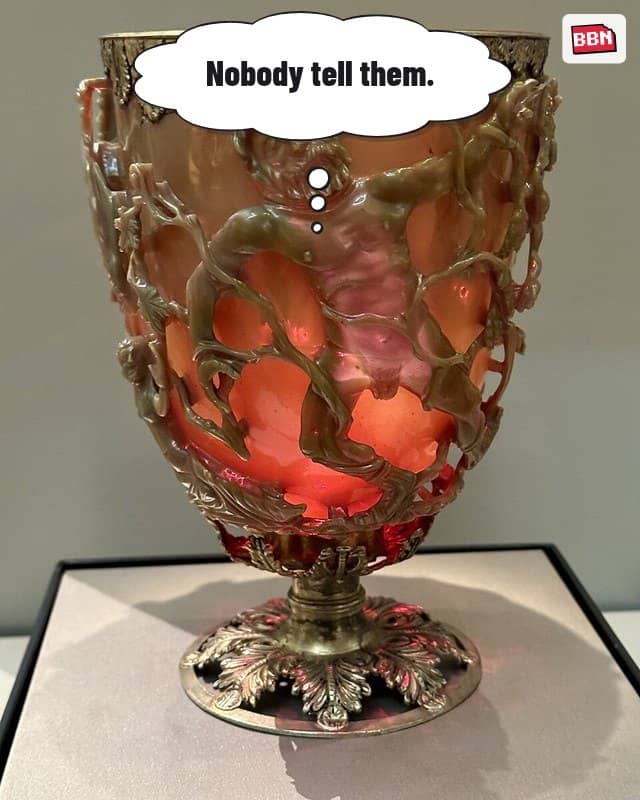 Photo: Chappsnet · CC BY 4.0 · Wikimedia Commons · altered by BBN
Watch it as it aired: Dr. Nina Byte and Kenji Moonfield on this story, from Best of BBN at 5:55 AM ET. Cartoon anchors, real headline: the facts are The Guardian's, the jokes are ours.
At a glance
- First reported by The Guardian: “‘It’s magic’: scientists rediscover how to make ancient Roman colour-changing glass”, with reporting from Wikipedia, ResearchGate (Journal of Glass Studies paper) and Beilstein Journal of Nanotechnology (via PubMed Central).
- Covered on BBN on Sunday, October 25, 2026, at 5:55 AM ET on Best of BBN, by Dr. Nina Byte and Kenji Moonfield.
- Topics: Roman.
- BBN covered this story before: Archaeologists discover major Roman roadside station in Spain (October 25).
The real story
The reporting behind this segment. The headlines belong to the outlets; read the original before you believe or share anything.
- The Guardian‘It’s magic’: scientists rediscover how to make ancient Roman colour-changing glass
- WikipediaLycurgus Cup facts used on air
- ResearchGate (Journal of Glass Studies paper)(PDF) The Lycurgus Cup-A Roman Nanotechnology facts used on air
- Beilstein Journal of Nanotechnology (via PubMed Central)Gold and silver dichroic nanocomposite in the quest for 3D printing the Lycurgus cup January 2, 2020 · facts used on air
What BBN said about it
Dr. Nina Byte · Tech & Science CorrespondentResearchers at the University of Sheffield are reported to have replicated the colour-changing glass of the Lycurgus Cup, which is sixteen hundred years old.
Dr. Nina Byte · Tech & Science CorrespondentIt looks jade green lit from the front and blood red lit from behind.
Kenji Moonfield · Internet & Trends CorrespondentSo is it painted? Is there a little light inside?
Dr. Nina Byte · Tech & Science CorrespondentNeither. Researchers say gold nanoparticles make the red and silver ones make the green.
Dr. Nina Byte · Tech & Science CorrespondentAbout forty parts per million of gold, and three hundred of silver.
Kenji Moonfield · Internet & Trends CorrespondentForty. So the cup is basically all glass and a rumour of gold.
Dr. Nina Byte · Tech & Science CorrespondentThe particles are about seventy nanometres across, too small for an ordinary optical microscope. The Romans did that somehow, and we needed until now.
Kenji Moonfield · Internet & Trends CorrespondentDoes this change anything for me?
Kenji Moonfield · Internet & Trends CorrespondentDid the Romans at least leave instructions?
More Shorts
All videos → Photo: Agent010 · CC BY-SA 4.0 · Wikimedia Commons
 Photo: Zalasem1 · CC BY 4.0 · Wikimedia Commons · altered by BBN
 Photo: Mtaylor848 · CC BY-SA 4.0 · Wikimedia Commons · altered by BBN, shared under CC BY-SA 4.0
 Photo: Rauno Kalda · CC BY-SA 3.0 ee · Wikimedia Commons · altered by BBN, shared under CC BY-SA 3.0 ee
 Photo: Benmckune at English Wikipedia · Public domain · Wikimedia Commons · altered by BBN




The story so far
- NASA's Roman Space Telescope exceeds expectations by nearly 30% · ScienceDaily
- Restorers work to preserve frescoes in one of Pompeii's grandest… · Euronews
- Roman coffin at Westminster Abbey holds a medieval skeleton · The Guardian
- Mystery of skeleton in Roman coffin at Westminster Abbey solved · Live Science
- Roman Coffin at Westminster Abbey Likely Held a Medieval Abbot · Smithsonian Magazine
- Archaeologists discover major Roman roadside station in Spain · HeritageDaily
- Scientists rediscover how Romans made colour-changing glass (this story)
From the archive: everything BBN aired on Sunday, October 25, 2026 · the U.S. archive · all months
More in U.S.
All U.S. →GLP-1 users find clothes shopping is its own journey
Circana found about eighty percent of GLP-1 users expect to need new clothes, and retailers are rethinking sizes and dressing rooms; the mirror is…


Leavitt says Trump is defying midterm headwinds on the trail
Trump's approval sits at thirty-one percent in a Reuters and Ipsos poll, the lowest of either term, as he campaigns for candidates ahead of November…
Durbin warns Democrats of regret after 30 Senate years
Durbin, retiring after thirty years, was one of ten Democrats who backed a GOP stopgap spending bill, which he called the responsible thing to do.

UCF stuns No. 2 BYU 39-31 in double overtime
Quarterback Keyone Jenkins threw for 293 yards and four total touchdowns, and the Big 12 may fine UCF for storming the field afterward.